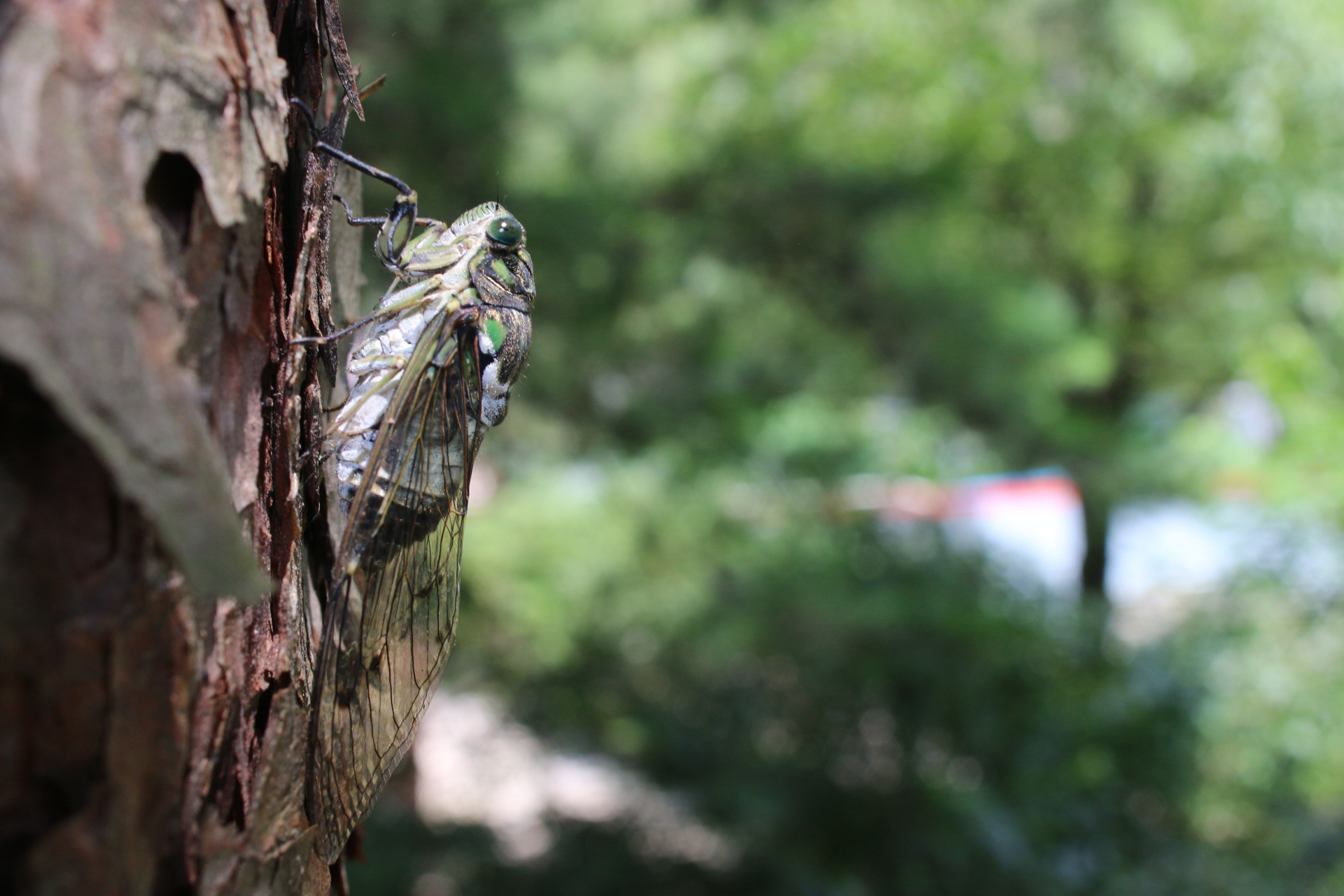
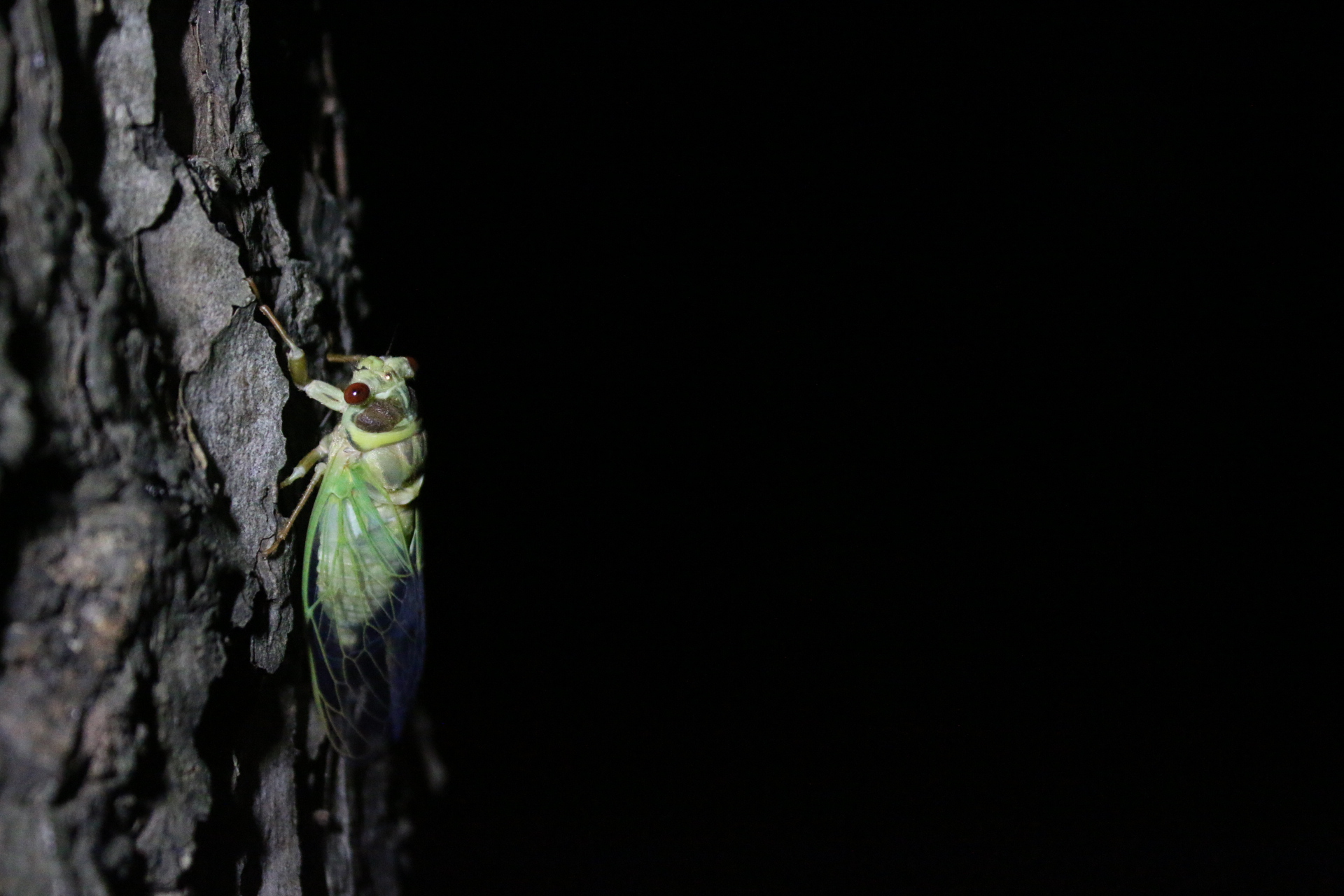
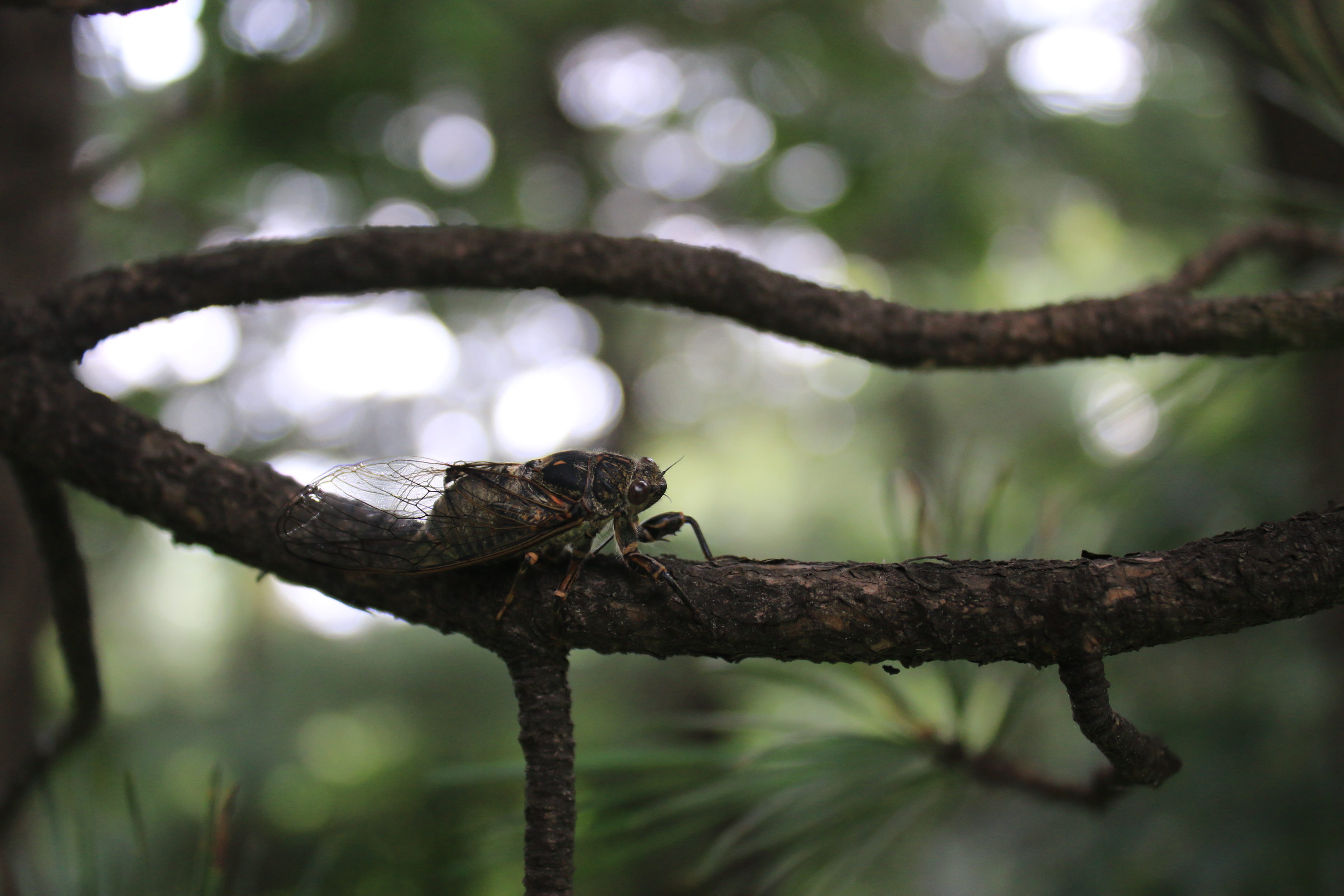
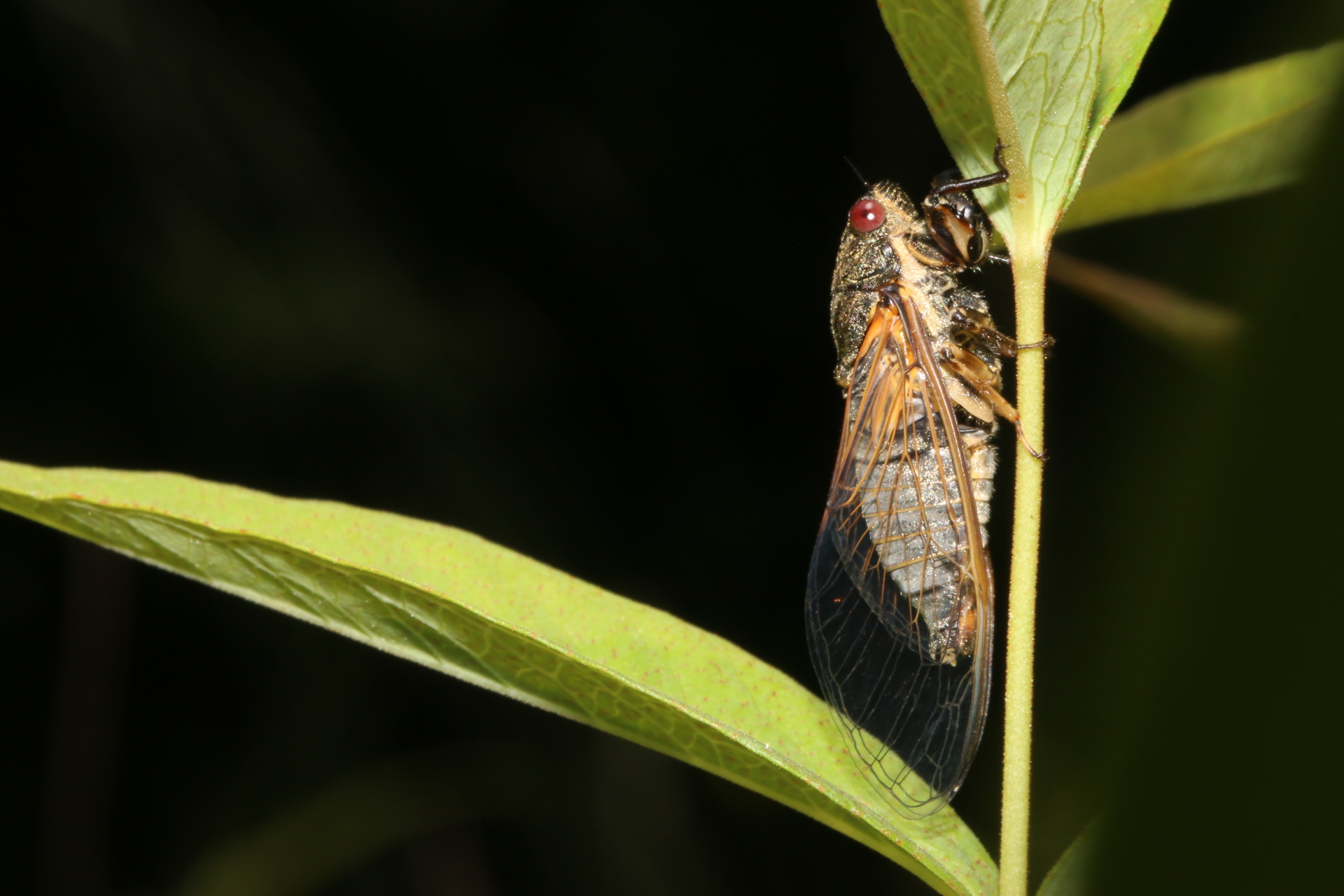
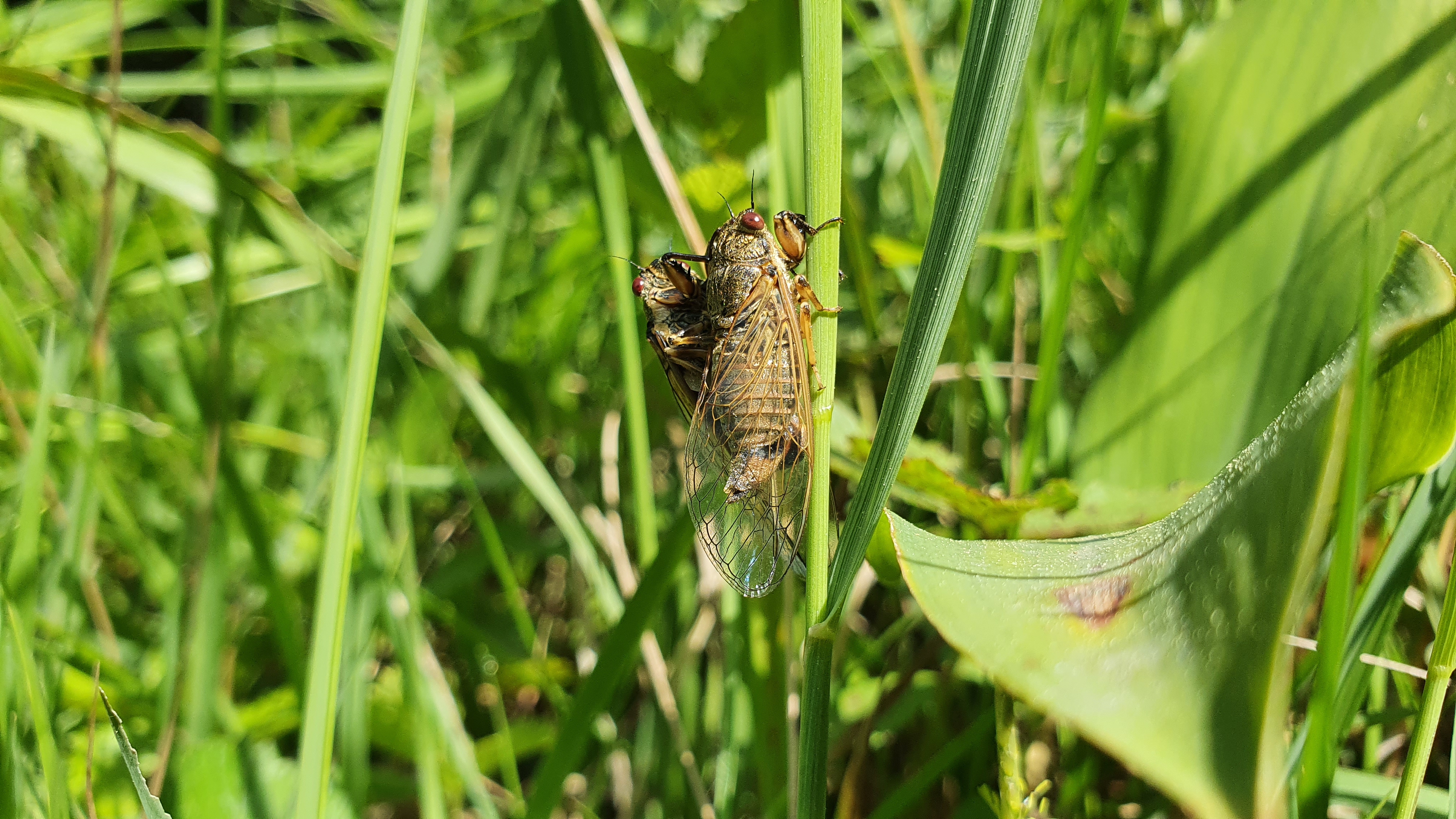
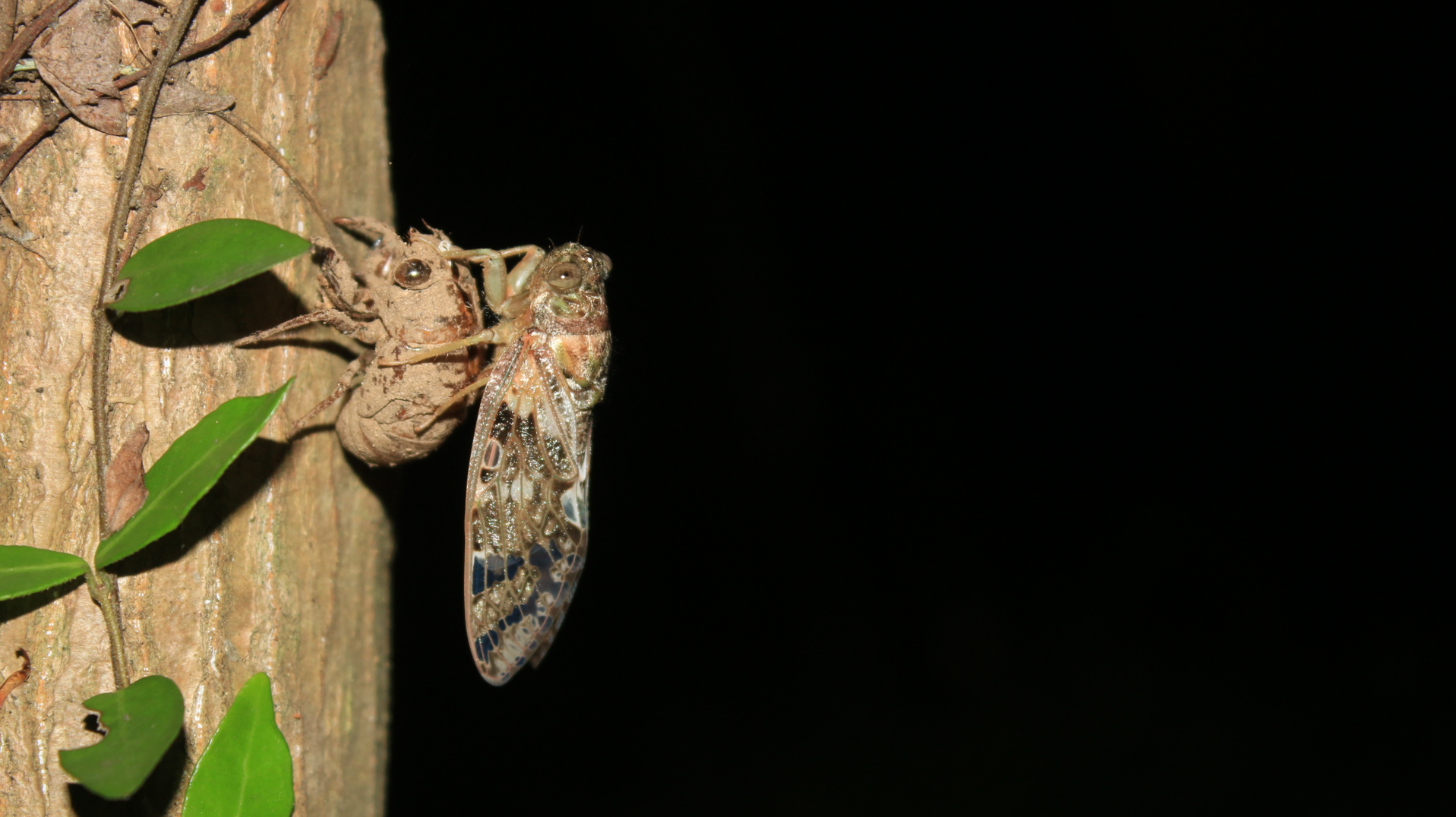
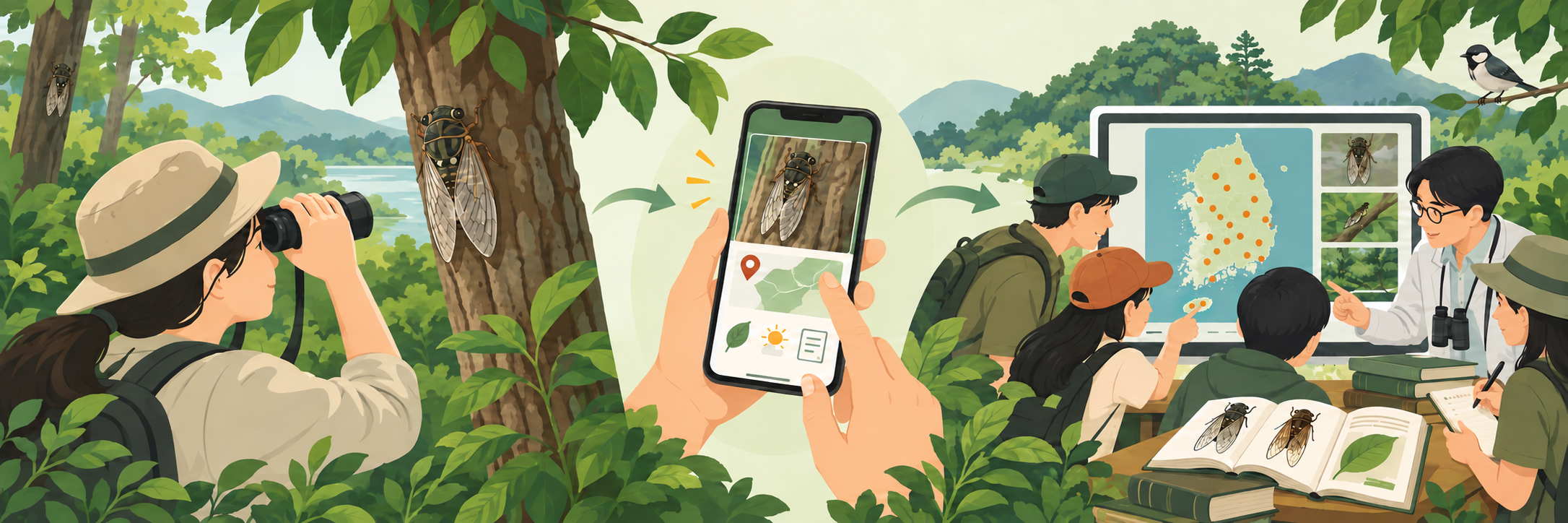
한국에서 관찰한 매미
01 / 06
KOREAN CICADA ASSOCIATION · EST. 2009

Korean Cicada Association

Field observations become records for research, education and conservation.

Explore projectsApply for membership
PROJECT PARTICIPATION

Cicada projects built from field records

Cicada field records contributing to research, education and conservation projects
  1. Field observation

    Document cicadas and their habitats through seasonal surveys and regular meetings.

  2. Research and archives

    Build verifiable photo, sound, distribution and ecology records for research.

  3. Education and public participation

    Connect records to education, conservation and citizen-science projects when appropriate.

FIELD WEATHER

Weather across Korea now

Current conditions can help you decide when and where to observe. Always check local alerts before heading out.

Loading current weather…

Today—Total—
Korean Cicada Association

About the Association

Studying and recording Korea’s cicadas.

The Korean Cicada Association brings together citizen observers, photographers, students and researchers to study cicadas and their habitats. The Association keeps reliable field records and shares verified information in an accessible form.

Purpose

Research · Records · Conservation · Education

The Korean Cicada Association surveys and documents Korea’s cicadas and their habitats, supports research and education, and promotes responsible observation and habitat conservation.

  1. 01
    Research and observation

    Study taxonomy, distribution, emergence, behaviour and song while connecting professional and citizen research.

  2. 02
    Records and sharing

    Organise photographs, recordings, field notes and regional data for future surveys and research.

  3. 03
    Habitat conservation

    Promote the value of forests, grasslands and urban green spaces while reducing harmful collection and disturbance.

  4. 04
    Education and exchange

    Share clear, accurate information and create opportunities to exchange knowledge and field experience.

Regional membership

Where members are active

See where members are active and where new members are welcome.

Regional membership counts in South KoreaUlleungdo · 0 membersLoading map…
Total membershipAll members3 members
Selected regionGyeonggi-do3 members
Overseas membershipOverseas members0 members
As of October 2026 · Updated as membership changes
ROOTS IN 2009
Records that began with a small online community

The Korean Cicada Association traces its roots to “Uri Maemi,” opened in 2009. Observation sharing continued through the “Korean Cicada” Facebook community from 2017, and the current organisational structure was established in 2026.

  1. 2009“Uri Maemi” online community opened
  2. 2017Observation sharing expanded through Facebook
  3. 2026Activities reorganised under the present structure
Korean Cicada Association

Notices

Membership, operating principles and important guidance.

4 notices
Membership

Membership applications are open

The Korean Cicada Association welcomes anyone who observes cicadas with care, from beginners to experienced photographers, recordists and researchers. There is currently no membership fee.

Applications are reviewed by the operator. Approved accounts can use the members-only area. We value consistent observation and respect for other people’s records more than prior expertise.

Korean cicada bibliography

Research records

Peer-reviewed studies and historical papers focused on cicadas of Korea and the Korean Peninsula.

37 journal papers

Select a title to open the paper in a new tab.

2026

Phylogeny한국산 계통분석 12종

Phylogenetic Analysis of Korean Cicada (Insecta: Hemiptera) Species Based on Mitochondrial and Nuclear Loci

Phylogenetic relationships among 12 Korean cicada species using mitochondrial COI and nuclear EF1α and 18S rRNA loci.

Hoa Quynh Nguyen · Sungsik Kong · Yoonhyuk Bae · Jiman Heo · Jae-Yeon Kang · Journal of the Entomological Research Society 28(2):89–107
Emergence ecology말매미 · 참매미 · 유지매미

Rainfall Timing as a Key Driver of Cicada Peak Emergence in Urban Habitats

A three-year Seoul study linking monsoon rainfall timing with peak emergence of three common urban cicadas.

Jae-Yeon Kang · Yong-Su Kwon · Heejo Lee · Yikweon Jang · Insects 17(2):226
TaxonomyLeptosemia inanulata

Leptosemia inanulata (Kishida, 1929) stat. rev. & comb. nov. (Hemiptera: Cicadidae)

A reassessment of the Korean taxon long treated as Leptosemia takanonis.

Young June Lee · Korean Journal of Applied Entomology 65(1):73–80
Population geneticsCryptotympana atrata

An Analysis of the Population Genetic Structure of Cryptotympana atrata (Hemiptera: Cicadidae) in South Korea Using Single-Nucleotide Polymorphisms from Direct Amplicon Sequencing

Population genetic structure of South Korean blackish cicadas using SNPs from direct amplicon sequencing.

Jeong Sun Park · Jee-Young Pyo · Heon Cheon Jeong · Sung-Soo Kim · Iksoo Kim · Journal of Entomological Science

2025

GenomicsCryptotympana atrata

Whole Genome Sequences of Cryptotympana atrata Fabricius, 1775 (Hemiptera: Cicadidae) in the Korean Peninsula: Insights into Population Structure with Novel Pathogenic or Symbiotic Candidates

Draft genomes, population structure and candidate symbiotic or pathogenic microbes of Korean blackish cicadas.

Jeong Sun Park · Jina Kim · Yeha Kim · Ki Hwan Kim · Woori Kwak · Iksoo Kim · Current Genomics 26(2)
Population geneticsCryptotympana atrata

Population genetics of the blackish cicada, Cryptotympana atrata (Cicadidae: Hemiptera), a climate-sensitive indicator insect in South Korea, using mitochondrial gene sequences

Mitochondrial COI analysis of genetic differentiation and gene flow among Jeju and mainland South Korean populations.

Jeong Sun Park · Jee-Young Pyo · Heon Cheon Jeong · Sung-Soo Kim · Iksoo Kim · International Journal of Industrial Entomology and Biomaterials 49(4):287–310

2024

Behaviour · physiologyTettigetta isshikii

Age-Related Plasticity Integration in Male Cicadas Tettigetta isshikii: Are Adult Cicadas Capital Breeders?

Tracks age-related changes in body mass, energy allocation and calling behaviour in male Tettigetta isshikii.

Jiman Heo · Chang S. Han · Ecology and Evolution 14(11):e70569
Bioacoustics · AI한국 자생 음성자료 12종

자생 매미 음성 분류를 위한 딥러닝 접근: 주파수 변화 분석과 모델 최적화

Deep-learning classification of spectrograms from 12 cicada species native to Korea.

장동석 · 홍윤식 · 한국산학기술학회논문지 25(7):403–408
Emergence ecology서울 도시공원 주요 6종

Temporal Patterns of Cicada Emergence in Two Urban Parks

Weekly exuviae surveys in two Seoul parks relate emergence patterns to temperature and humidity.

Jae-Yeon Kang · Heejo Lee · Yong-Su Kwon · GEO DATA 6(4):347–353

2023

Urban ecology서울 도시공원 주요 6종

Investigation of Cicada Density in Urban Park

A survey of 7,369 exuviae documenting species density and seasonal change across 18 Seoul parks.

Jae-Yeon Kang · Yong-Su Kwon · GEO DATA 5(2):87–91
PhylogenyHyalessa fuscata

A time-calibrated mitogenomic phylogeny suggests that Korean Hyalessa fuscata is a bridge between Chinese and Japanese H. maculaticollis

A mitogenomic comparison of Korean, Chinese and Japanese Hyalessa lineages and their divergence times.

Hoa Quynh Nguyen · Phuong-Thao Ho · Sungsik Kong · Yoonhyuk Bae · Thai Hong Pham · Huyen Thi La · Yikweon Jang · Journal of Genetics 102:9

2022

Life historyHyalessa fuscata

An effective method for accurate nymphal-stage delimitation of the cicada Hyalessa fuscata

A morphometric and statistical framework delimiting five nymphal stages in Korean Hyalessa fuscata.

Hoa Quynh Nguyen · Erick Kim · Yoonhyuk Bae · Soyeon Chae · Seongmin Ji · Jiman Heo · Sungsik Kong · Thoa Kim Nguyen · Thai Hong Pham · Yikweon Jang · Journal of Asia-Pacific Entomology 25(3):101952
BioacousticsAuritibicen intermedius

생물음향탐지기법을 활용한 한국 참깽깽매미 서식 및 번식울음 특성 연구

Long-term acoustic monitoring of distribution and environmental drivers of calling in Auritibicen intermedius.

김윤재 · 기경석 · 한국환경생태학회지 36(6):592–601

2021

Bioacoustics전국 보호지역 조사 9종

생물음향 탐지기법을 이용한 한국 매미아과의 출현 시기 및 서식지 분포 특성 연구

Bioacoustic monitoring at 19 protected areas documented calling seasons and distributions of nine Korean species.

김윤재 · 기경석 · 한국환경생태학회지 35(6):594–600

2020

Physiology · climateC. atrata · H. fuscata

Not all cicadas increase thermal tolerance in response to a temperature gradient in metropolitan Seoul

A comparison of morphology and heat tolerance across metropolitan Seoul’s temperature gradient.

Hoa Quynh Nguyen · Hortense Serret · Yoonhyuk Bae · Seongmin Ji · Soyeon Chae · Ye Inn Kim · Jeongjoo Ha · Yikweon Jang · Scientific Reports 10:1343
Identification한국산 매미 4종

Rapid and Simple Species Identification of Cicada Exuviae Using COI-Based SCAR Assay

A COI-based marker assay for identifying exuviae of four cicada species occurring in Korea.

Pureum Noh · Wook Jin Kim · Jun-Ho Song · Inkyu Park · Goya Choi · Byeong Cheol Moon · Insects 11(3):168

2019

Morphology한국산 매미 4종

Comparative Morphological, Ultrastructural, and Molecular Studies of Four Cicadinae Species Using Exuvial Legs

Morphology, ultrastructure and DNA of exuvial legs were compared for reliable identification.

Jun-Ho Song · Wook Jin Kim · Ji-Min Cha · Sungyu Yang · Goya Choi · Byeong Cheol Moon · Insects 10(7):199
Population geneticsC. atrata · H. fuscata

Characterization of polymorphic loci for two cicada species: Cryptotympana atrata and Hyalessa fuscata (Hemiptera: Cicadoidae)

Microsatellite marker panels for population studies of two abundant cicada species in Seoul.

Hoa Quynh Nguyen · Soyeon Chae · Erick Kim · Yikweon Jang · Molecular Biology Reports 46:1555–1561
BioacousticsLeptosemia inanulata · Auritibicen intermedius · Kosemia yezoensis · Hyalessa fuscata · Meimuna opalifera

태백산국립공원에 서식하는 매미류의 생물음향 및 서식환경 분석

Bioacoustic and habitat analysis of five cicada species in Taebaeksan National Park.

김윤재 · 정태준 · 기경석 · 한국환경생태학회지 33(6):664–676
Taxonomy · phylogenySuisha coreana

Out of Africa? A dated molecular phylogeny of the cicada tribe Platypleurini Schmidt (Hemiptera: Cicadidae), with a focus on African genera and the genus Platypleura Amyot & Audinet-Serville

A dated phylogeny and biogeographic analysis including a South Korean Suisha coreana sample.

Benjamin W. Price · David C. Marshall · Nigel P. Barker · Chris Simon · Martin H. Villet · Systematic Entomology 44(4):842–861

2018

Acoustic ecology도시·산림 조사 7종

도시와 산림지역 매미과 번식울음 차이 연구

Compares daily calling patterns and weather effects between urban Seoul and forest habitat in Chiaksan.

김윤재 · 기경석 · 한국환경생태학회지 32(6):698–708
Acoustic ecologyHyalessa fuscata · Cryptotympana atrata

매미과 울음 시작 및 종료에 영향을 미치는 환경요인 ― 참매미, 말매미를 대상으로

Environmental factors associated with the start and end of calling by Hyalessa fuscata and Cryptotympana atrata in Seoul.

김윤재 · 기경석 · 한국환경생태학회지 32(3):342–350
Urban ecologyC. atrata · H. fuscata

Urban heat island effect on cicada densities in metropolitan Seoul

Exuviae surveys at 36 sites tested how urban heat-island intensity relates to cicada density.

Hoa Q. Nguyen · Desiree K. Andersen · Yuseob Kim · Yikweon Jang · PeerJ 6:e4238
Taxonomy · phylogenyAuritibicen intermedius

Revision, phylogeny and phylogeography of the cicada genus Auritibicen (Hemiptera: Cicadidae), with descriptions of ten new species

A morphological, molecular and biogeographic revision including the Korean species Auritibicen intermedius.

Xu Wang · Masami Hayashi · Cong Wei · European Journal of Entomology 115:53–103

2017

Molecular methodsCryptotympana atrata

Efficient isolation method for high-quality genomic DNA from cicada exuviae

Comparison of DNA extraction protocols using blackish cicada exuviae collected in Seoul.

Hoa Quynh Nguyen · Ye Inn Kim · Amaël Borzée · Yikweon Jang · Ecology and Evolution 7(20):8161–8169

2015

TaxonomyKosemia yezoensis · Kosemia admirabilis

A review of the cicada genus Kosemia Matsumura (Hemiptera: Cicadidae)

A taxonomic review of Kosemia, including species recorded from the Korean Peninsula.

Shengping Qi · Masami Hayashi · Cong Wei · Zootaxa 3911(4):451–492

2014

Urban ecologyHyalessa fuscata · Cryptotympana atrata · Graptopsaltria nigrofuscata · Meimuna spp.

Host availability hypothesis: complex interactions with abiotic factors and predators may best explain population densities of cicada species

Exuviae censuses across urban, suburban and rural habitats tested explanations for cicada density.

Tae Eun Kim · Seung-Yoon Oh · Eunmi Chang · Yikweon Jang · Animal Cells and Systems 18(2):143–153

2013

Bioacoustics한국 자생 매미 12종

한국산 매미 소리를 표현하는 용어 연구

A terminology framework describing the call phases of 12 cicada species occurring in South Korea.

윤기상 · 김기경 · 서홍렬 · 한국환경생태학회 학술대회논문집 23(2):89–90

2012

ExuviaeCryptotympana atrata · Hyalessa fuscata · Graptopsaltria nigrofuscata · Meimuna opalifera · Meimuna mongolica

Morphometrics of the final instar exuviae of five cicada species occurring in urban areas of central Korea

Morphometric characters and an identification key for final-instar exuviae of five common species.

Hyung-Yun Lee · Seung-Yoon Oh · Yikweon Jang · Journal of Asia-Pacific Entomology 15(4):627–630

2008

Taxonomy한반도 매미과

Revised synonymic list of Cicadidae (Insecta: Hemiptera) from the Korean Peninsula, with the description of a new species and some taxonomic remarks

A revised synonymic list of Korean Peninsula Cicadidae, including a new species and taxonomic remarks.

Young June Lee · Proceedings of the Biological Society of Washington 121:445–467

2007

BiochemistryCryptotympana dubia

Isolation and functional analysis of a 24-residue linear alpha-helical antimicrobial peptide from Korean blackish cicada, Cryptotympana dubia (Homoptera)

Isolation and functional analysis of an antimicrobial peptide from a Korean blackish cicada.

Doo-Sang Park · Jae Yoon Leem · Eun Young Suh · Jang Hyun Hur · Hyun-Woo Oh · Ho-Yong Park · Archives of Insect Biochemistry and Physiology 66(4):204–211

2004

Taxonomy · habitatCicadetta pellosoma · Tettigetta isshikii

A New Habitat of Cicadetta pellosoma and Cicadetta isshikii (Hemiptera, Cicadidae) in Korea and Their Variations in Body Coloration

A new sympatric locality on Mt. Gwangdeoksan and colour variation between two cicada taxa.

Young June Lee · Hae-Yong Oh · Sang Gyu Park · Journal of Asia-Pacific Entomology 7(1):127–131

2002

ParasitismEpipomponia nawai · Meimuna opalifera

Notes on a Cicada Parasitic Moth in Korea (Lepidoptera: Epipyropidae)

Korean record and life stages of the cicada-parasitic moth Epipomponia nawai, recorded from Meimuna opalifera.

Jeong-Bae Jeon · Tae-Woo Kim · Pierre Tripotin · Jin-Ill Kim · Entomological Research 32(4):239–241

1999

Taxonomy · checklist한국산 매미과

A List of Cicadidae (Homoptera) in Korea

An early consolidated checklist of Korean Cicadidae with distributional and historical records.

Young June Lee · Cicada 15(1):1–16

1998

Habitat · behaviourCicadetta montana

Habitat and habits of Cicadetta montana (Homoptera, Cicadidae) in Korea

An early account of habitat and behaviour of the Cicadetta montana complex in Korea.

Young June Lee · Cicada 13:59–61

1931

Taxonomy · checklist한반도 매미과

Cicadas of Korea

An early taxonomic account and illustrated record of the cicada fauna of Korea.

T. Mori · Journal of the Chosen Natural History Society 12:10–24, pls. 1–2
Species descriptionChosenosemia souyoensis

A new species of Cicadinae from Korea

The original description of Chosenosemia souyoensis from Mt. Soyo, Korea.

H. Doi · Journal of the Chosen Natural History Society 12:52–53
CITIZEN SCIENCE · iNATURALIST

Projects

Current projects documenting cicadas in Korea and activities led by the Association.

CURRENT PROJECT

Cicadas in South Korea

A citizen-science project collecting cicada observations made across South Korea. Its records help document species diversity, distribution, seasonality, phenology and ecological interactions.

Collection projectSouth Korea · Cicadidae

Add your observation to the national record

Observations uploaded to iNaturalist are brought together when they are cicadas recorded in South Korea. You can contribute by recording the date and location and adding a photograph or sound whenever possible.

  1. 01Record a cicada you observed in South Korea.
  2. 02Add the observation date and location.
  3. 03Attach photographs or sound and review identifications with the community.
Open the iNaturalist project ↗
OBSERVE · LEARN · RECORD

Regular Meetings

Seasonal field observation and thoughtful exchange.

01

Schedule and place

Each announcement will include the date, meeting point, expected duration and observation focus.

02

Who can join and what to bring

Meetings will generally welcome members and non-members. Bring suitable shoes, water, sun protection and a notebook; cameras and recording equipment are optional.

03

Registration

Meeting registration is kept separate from general enquiries. The current application form is available in Korean.

Open the meeting application →
04

Past meeting records

After the first meeting, we will publish observed species, a broad location and what participants learned without revealing sensitive sites.

05

Rain and cancellation

Unsafe rain, heat or storms may cause postponement or cancellation. Registered participants will be contacted whenever possible by the previous day.

06

Habitat and field rules

Do not touch emerging cicadas or damage vegetation. Follow access rules, prioritise observation over collecting and leave no trace.

Membership

Join the Club

Everyone with an interest in cicadas is welcome.

Membership applications

Membership is open to people interested in observation, photography, sound recording, research, education and conservation. There is currently no fee.

Apply using the Korean form →
Magazine

KCA Magazine

Field observations, research updates and stories from members.

Sample inaugural cover

The current cover is an editorial design sample based on a night-time cicada emergence. Publication details may change.

View the cover sample →
Contact

Get in touch

Enquiries about collaboration, records and the website.

Send us your question.

We welcome enquiries from observers, researchers, educators and existing nature communities.

Open the Korean contact form →
Working together

Collaboration built on mutual respect

The Korean Cicada Association welcomes cooperation with established nature communities, individual observers, researchers, educators and citizen-science projects.

  • Joint regional surveys
  • Photo, sound and distribution data
  • Talks and ecological education
  • Habitat conservation projects
Members

Members-only archive

A shared area for approved members.

Member resources

Access is available to accounts whose membership application has been approved.

Open the members-only area →